
Black-crowned Night Heron
Black-crowned Night Heron
Nycticorax nycticorax
Status: migratory
Arrives: mid-March
Departs: mid-October, with rare sightings in November
Photos: More black-crowned night heron photos
 The black-crowned night heron, Nycticorax nycticorax, could be considered the poster bird for the Toronto Islands. Arriving soon after ice-out, their familiar hunched shape can be seen napping in trees or hunting in the shallows Island-wide. Their numbers are always more numerous than their great blue and great egret cousins, but like them the night heron does not breed on the Islands. When startled, a night heron will defecate, emit a gutteral squawk, and take flight to put distance between itself and the intruder.
Arriving in mid to late march from their overwintering grounds in Mexico and the southern United States, flocks of up to a dozen night herons will crowd together for a few weeks, staying together in their migratory group. They nest in Tommy Thompson park, but spend a lot of time fishing on the Islands. Night herons are active primarily at night, standing motionless on logs or in shallow water waiting for small fish to swim close. They can often be seen at night perched on the rocks off of the boardwalk on the south side of the Island.


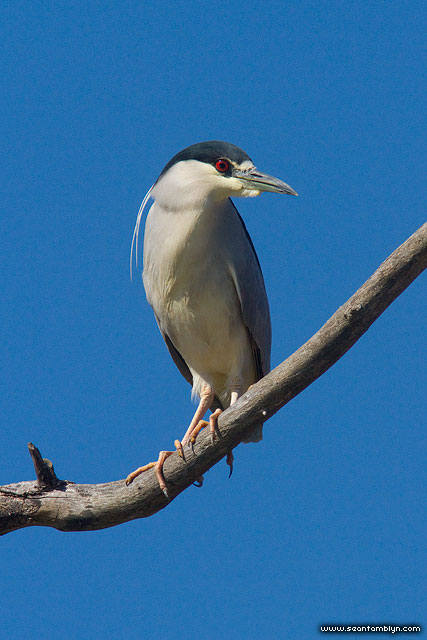
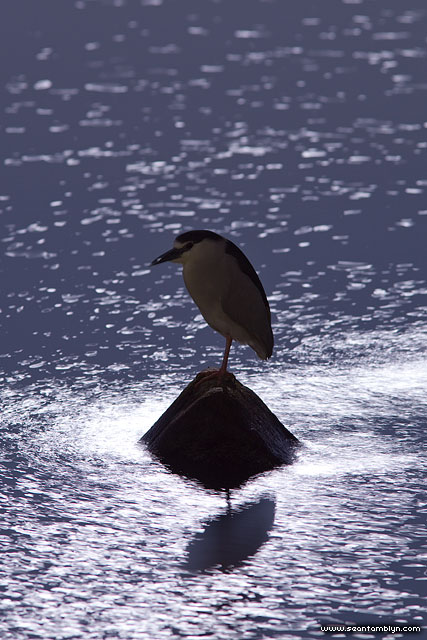 Above, from left to right: a juvenile black-crowned night heron hunts on a log at night; the distinctive spots on the feathers of another juvenile; a mature night heron by day in March and another backlit by the rising moon in May. Top: a mature night heron wings its way past the camera in early March.
Juvenile night herons are primarily brown, with white spots on their feathers. As they mature, their eyes turn bright red, with a dark head and back and light underside, and two or three long white plumes extending from the back of the head. Unlike the great herons and egrets, they have a short, stocky shape, with a hunched appearance. Rarely they’ll stretch their neck out, which is surprisingly long given their usual posture.
In 2012 the first night heron was spotted on March 14, and in 2009 the last heron was spotted on November 7. Some night herons have been photographed sporting identification bands, but who runs the tracking program is still unknown.